As 5G SA adoption accelerates, network performance alone no longer reflects user experience.
Even when throughput and latency meet target levels, users may still encounter buffering, resolution drops, or delayed responsiveness?highlighting a critical reality: good QoS does not always translate into good QoE.
Why QoE Matters More in the 5G SA Era
Why KPI-Based Evaluation Is No Longer Enough

What Experience-Centric Validation Requires
To make QoE measurable and actionable at scale, a more structured validation approach is needed.
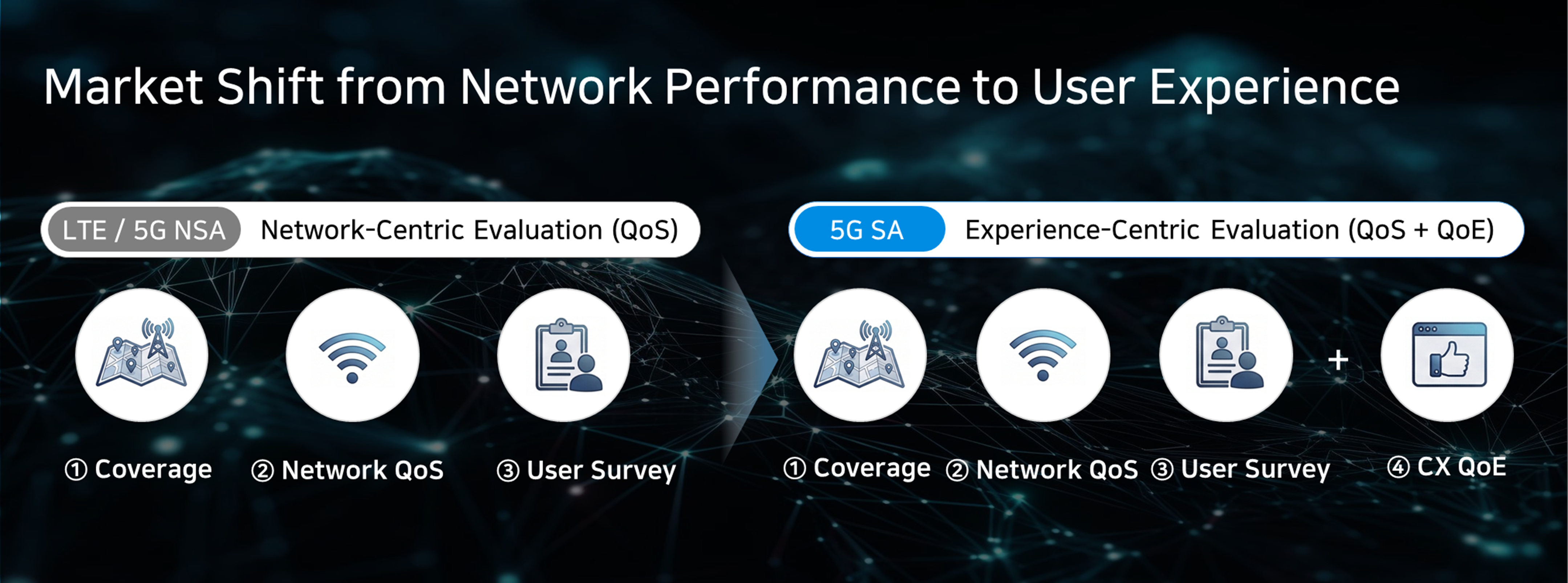
A QoE-driven framework should combine network performance, service-level behavior, and perceptual quality. This makes it possible to evaluate how users actually experience services such as video streaming, web browsing, cloud applications, messaging, and real-time communication.
Experience-centric validation must also be fair, repeatable, and comparable. Test conditions should therefore be controlled through harmonized methods, synchronized measurements, representative service scenarios, consistent device conditions, and neutral test configurations.
To be effective in practice, QoE validation must also be scalable. That requires standardized environments, automated testing, centralized analytics, and validation based on real commercial devices and real application behavior, not only synthetic traffic.
How Accuver Enables Scalable QoE Validation
Accuver supports this transition through an integrated validation framework designed for real-world network environments.
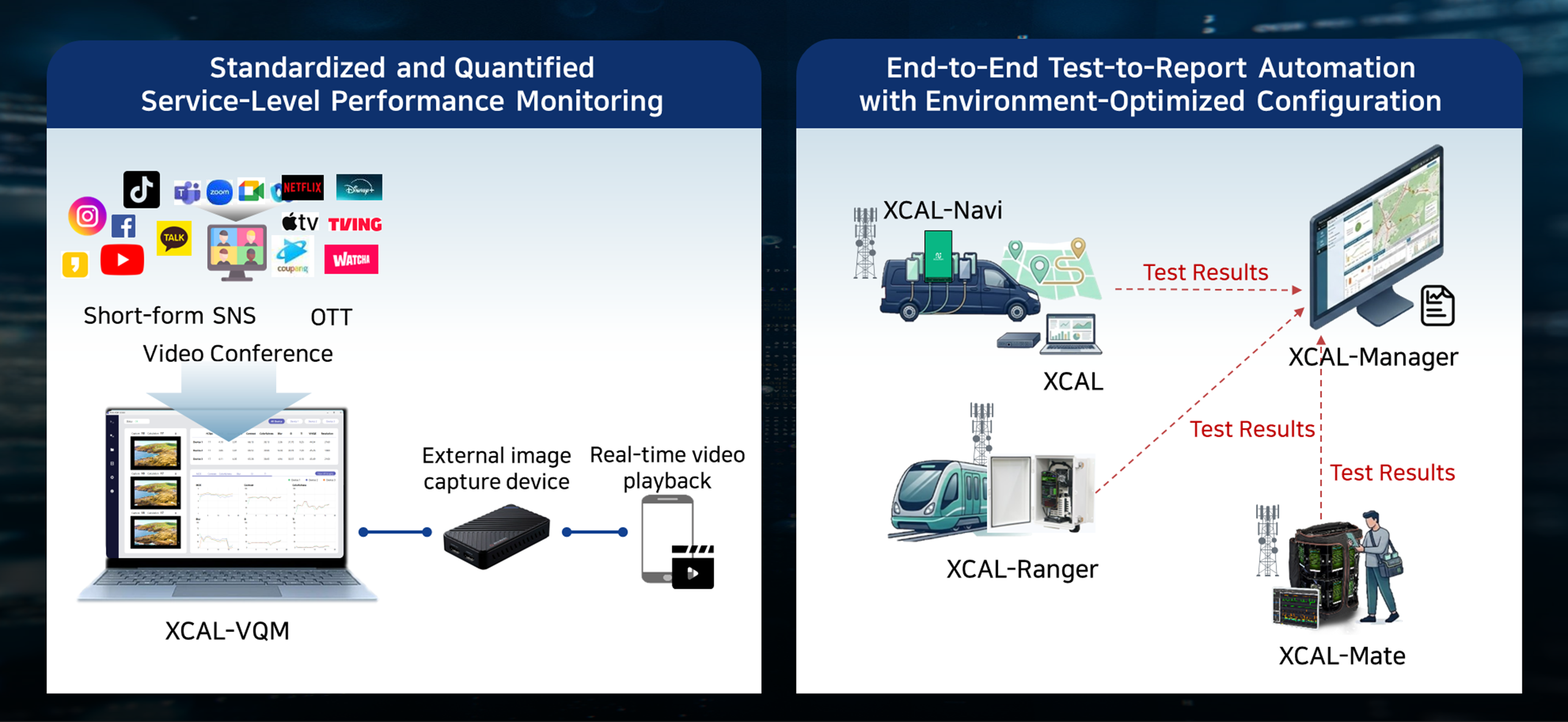
XCAL enables reliable field testing and service-level measurement under live network conditions. It supports QoE evaluation not only for voice and video calls, but also for OTT and messaging applications such as WhatsApp and other app-based services. It can be deployed across mobility scenarios, 24/7 continuous monitoring, indoor locations, and non-terrestrial network (NTN) scenarios. XCAL also incorporates Accuver’s VQML™ technology, which delivers real-time objective video quality assessment based on machine learning.
XCAL-Manager strengthens this framework with centralized control, automation, and real-time monitoring for large-scale operations. It supports repeatable testing, statistical comparison across devices and network environments, and automation that reduces time and manpower.
XCAP extends this workflow with advanced post-processing and QoE analytics, helping teams correlate network behavior with actual service outcomes and user experience. Its AI-based root cause analysis capabilities also provide guidance on likely causes and recommended follow-up actions.
Together, these capabilities support continuous monitoring, multi-device validation, service benchmarking, and AI-based video quality assessment across diverse deployment environments.
Closing the Gap Between Network Performance and Real Experience
Experience-centric validation is becoming essential across diverse markets and use cases. It is increasingly relevant for nationwide benchmarking, regulatory assessment, device evaluation, service launch verification, software comparison, mobility scenarios, and large-scale operational monitoring.
QoE-driven validation is no longer experimental. It is becoming a practical requirement for understanding how network quality is actually delivered to end users.

As networks evolve, so must the definition of quality. Network performance shows what a network is capable of, but user experience determines the quality users actually receive. Accuver helps operators, vendors, and ecosystem partners close this gap through an integrated approach that combines standardized testing, automated measurement, and service-level analytics across real-world network environments.
 List
List