

The wireless communication landscape is undergoing a radical shift as Non-Terrestrial Networks (NTN) move from theory to reality. We have entered an era of "coverage without boundaries," driven by an unprecedented scale of satellite deployment. As of early 2026, the number of active Low Earth Orbit (LEO) satellites has surged past 12,500, creating a dense celestial network designed to eliminate global coverage gaps. This orbital infrastructure now supports over 10 million satellite broadband subscribers worldwide, while the emerging "Direct-to-Device" (D2D) market is projected to connect a potential audience of over 2 billion people through global cellular integration.
However, the leap to space comes with unique technical hurdles. The extreme altitudes of Low Earth Orbit (LEO) introduce massive propagation delays, while the high velocity of satellites creates significant Doppler shifts that can disrupt traditional mobile protocols. Ensuring seamless connectivity between these satellites and ground devices requires a rigorous, dual-phase testing strategy―beginning with high-fidelity simulation in a controlled lab environment and concluding with extensive optimization under real-world field conditions.
Accuver is proud to introduce a complete end-to-end NTN test suite designed to empower UE manufacturers, base station developers, and network operators to navigate this high-stakes frontier with confidence.
NTN Satellite Link Simulation & Analysis
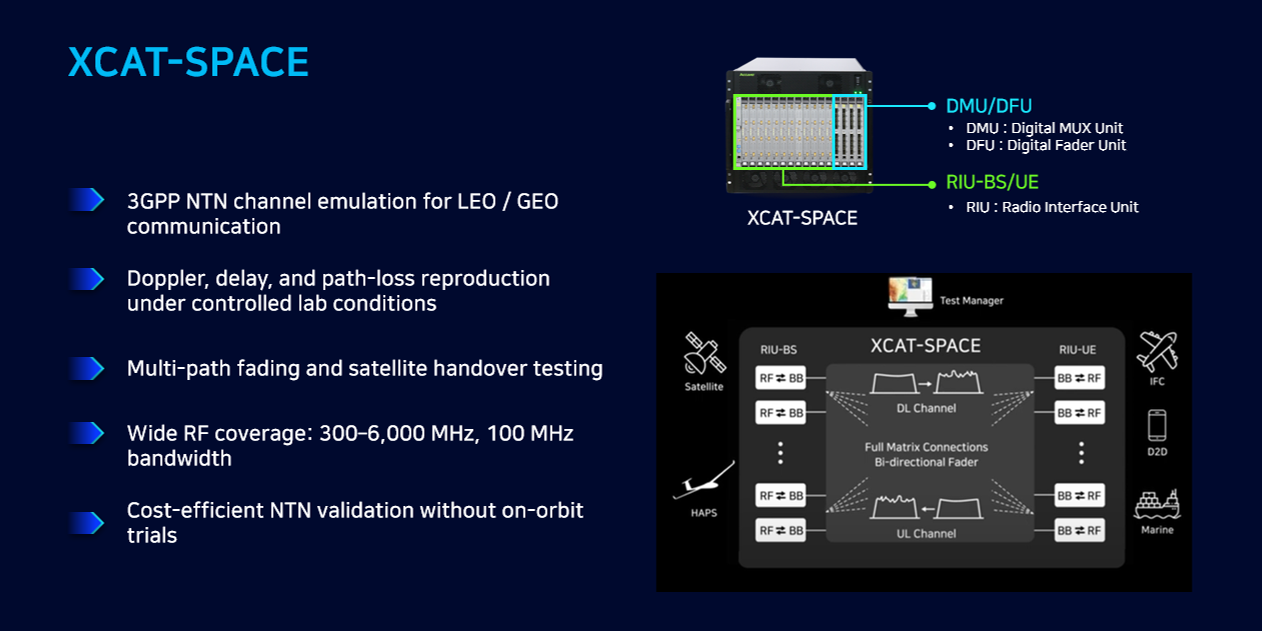
XCAT-SPACE enables controlled and repeatable NTN validation, allowing developers to test their systems against thousands of orbital scenarios in a fraction of the time. This is achieved by precisely simulating LEO-based satellite link conditions―including dynamic propagation delays, complex Doppler effects, orbital mobility, and multi-satellite visibility―ensuring every aspect of the satellite link is rigorously accounted for.
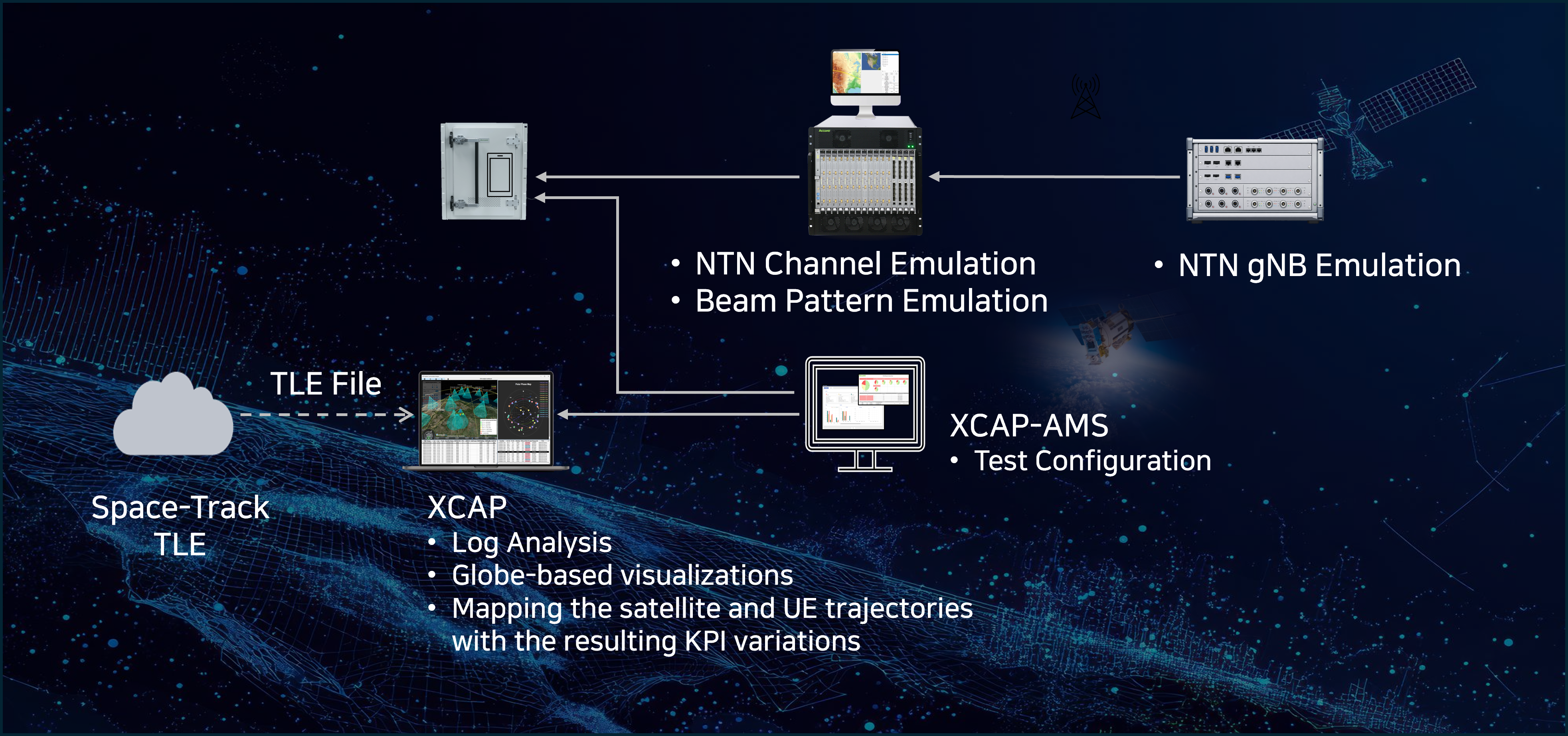
The system provides dynamic satellite mobility based on actual orbits. Users can manually configure altitude, trajectory, and terminal movement paths, or achieve even higher precision by automatically importing TLE (Two-Line Element) orbit data. This flexibility allows for comprehensive 5G NR NTN terminal testing and D2D LTE end-to-end validation. For those requiring a perfectly isolated environment, pairing XCAT-SPACE with Accuver’s XCAT-SmartShield or XCAT-Shield Box provides a high-fidelity Over-the-Air (OTA) testing setup. These highly controlled conditions closely approximate wired connections, minimizing external RF uncertainty while preserving essential OTA characteristics.
By combining satellite channel emulation with controlled OTA testing, Lab validation supports accurate and repeatable evaluation of NTN devices prior to Field verification.
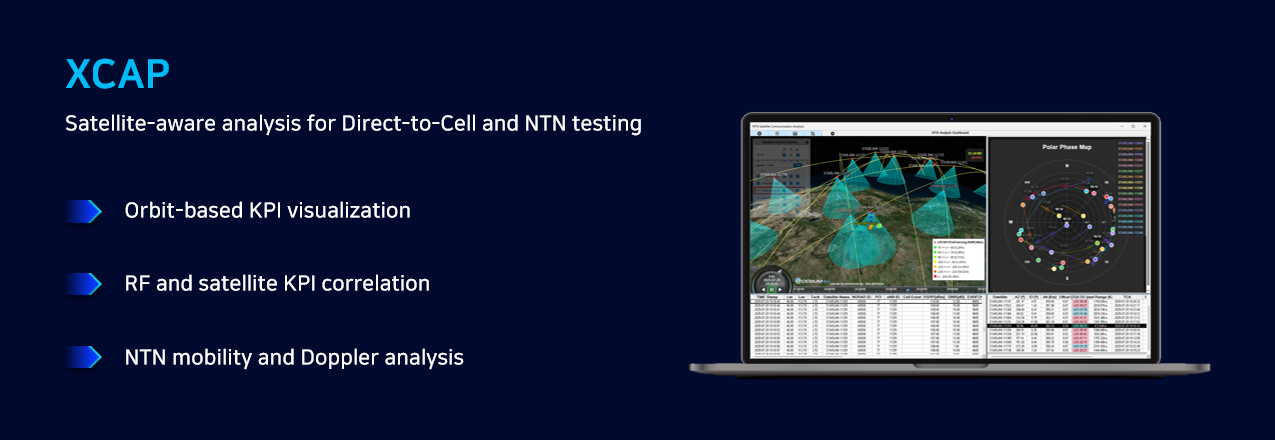
To translate this simulation into meaningful intelligence, XCAP, a post-processing solution, delivers specialized NTN analysis. Since satellite base stations are constantly in motion, XCAP uses 3D map visualization and automated TLE (Two-Line Element) data to correlate RF KPIs with precise satellite positions, azimuth, and elevation at the moment of measurement. This provides a clear performance baseline for 5G NR NTN and D2D solutions across major chipsets.
Managing these complex testing cycles is streamlined by XCAP-AMS, a web-based automation platform. By centralizing system control and test reporting into an intuitive web UI, XCAP-AMS eliminates location dependency and reduces operational complexity. Together, this ecosystem―from XCAT-SPACE’s high-fidelity emulation to XCAP’s orbital insights and XCAP-AMS’s centralized management―provides a seamless, repeatable path for NTN device evaluation prior to field verification.
24/7 Unmanned Satellite D2C Monitoring Solution

Accuver enables this through a 24/7 unmanned satellite D2C monitoring solution , designed to capture RF performance, service availability, and mobility behavior across distributed locations using live LEO satellites.
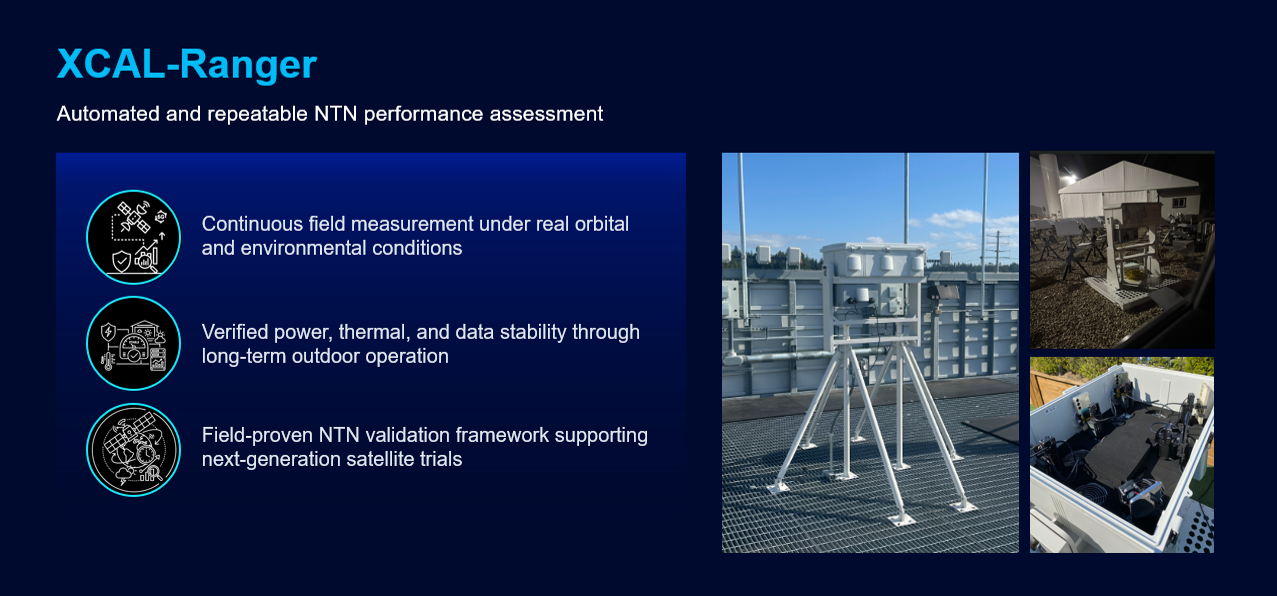
At the heart of field operations are specialized measurement probes tailored for mission-critical NTN environments. For deployments in regions where terrestrial networks are unavailable―such as mountainous areas, deserts, or polar zones―the XR-Emb provides a rugged, IP54-rated solution. It ensures stable, automated testing (Ping, PS Call, SMS) in extreme outdoor conditions, supporting real-time status monitoring and failover handling for emergency or remote operations. For multi-UE monitoring, the XR-Pu6 enables continuous 24/7 benchmarking of up to six devices simultaneously. This ensures that operators never miss critical testing opportunities caused by unpredictable satellite pass times, providing a robust verification of satellite coverage and D2C (Direct-to-Cell) performance in the field.
These distributed field units are centrally managed by XCAL-Manager, a server platform that eliminates the need for on-site engineers in remote or inaccessible areas. Operators can remotely distribute measurement schedules, monitor satellite links in real-time, and receive automated alarms for network anomalies, significantly reducing OPEX. All measurement data from these multiple sites is then aggregated via XCAP-AMS for consistent data handling and unified platform management.
For large-scale or geographically distributed deployments, XCAP serves as the centralized engine for deep-dive analysis. This post-processing solution correlates RF KPIs with real-time satellite dynamics―including azimuth, elevation, Doppler shifts, and free space path loss―derived from TLE-based orbit information. This end-to-end field ecosystem ensures that NTN services are rigorously monitored and optimized in the real world, from the remote edge to the central cloud.
Unified NTN Validation Workflow
Accuver’s NTN solution provides:
ㆍSatellite link simulation, controlled OTA testing, and baseline analysis in the Lab
ㆍContinuous 24/7 unmanned D2C monitoring in the Field
ㆍCentralized operation, data aggregation, and integrated analysis
ㆍConsistent KPI correlation across Lab and Field environments
Together, these capabilities support a single, structured NTN validation workflow from simulation to live satellite operation.
Conclusion
NTN validation requires both controlled simulation and real-satellite verification.
Accuver delivers a
structured, end-to-end NTN validation solution
that enables reliable deployment, efficient troubleshooting, and continuous optimization of satellite-based networks.
 List
List