LIG Accuver’s AI-Based Video Quality Assessment Technology Adopted as Global Standard, Taking Flight

 Thumbnail.png
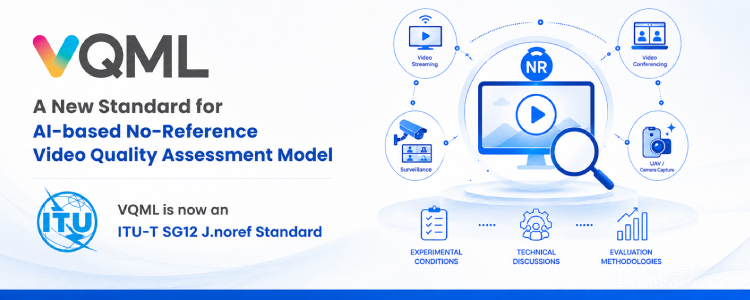
At the recent ITU-T Study Group 12 plenary meeting held in Geneva, Switzerland, VQML, an AI-based no-reference video quality assessment model independently developed by LIG Accuver, a Korean telecommunications solutions specialist formerly known as Innowireless, was officially adopted as “MODEL A” of the next-generation international standard J.noref and has entered the final Approval Process stage.
VQML is an innovative technology that predicts real-time visual quality of experience, or MOS, using only received RGB video, without requiring an original reference video or transmission metadata. The technology has already completed commercial validation for National Information Society Agency disaster network verification, as well as with global mobile operators and network equipment vendors. In addition, during the same meeting, a proposal led by LIG Accuver in collaboration with Yonsei University, titled “Performance Analysis of Reference Quality Assessment for Impaired Reference Video,” was adopted as a new Work Item. This is expected to serve as an important milestone demonstrating Korea’s leadership in global media QoE assessment standardization.
This achievement carries significant implications for Korea’s telecommunications industry, as it proves the competitiveness of proprietary technology developed by a Korean mid-sized company amid competition with global big tech companies backed by vast capital and massive datasets. In fact, Track 1 of the J.noref standard document includes LIG Accuver’s VQML alongside UVQ, the quality assessment model from YouTube, the world’s leading video platform, and YSNR from Yonsei University.
According to rigorous performance tests conducted using the ITU-T standardization evaluation dataset, VQML recorded a Pearson Linear Correlation Coefficient, or PLCC, of 0.8653, demonstrating higher prediction accuracy than the open-source UVQ model, which recorded 0.8146. In Track 2, which selects standard models for evaluating video quality when camera-status-related impairments are present, VQML was also adopted as a standard with a PLCC score of 0.8077, while UVQ, which scored 0.7103, was not included in the standard.
At the core of this performance differentiation is VQML’s proprietary Multi-Score VQA architecture. VQML combines Transformer and CNN technologies and applies the CLIP model, which is capable of understanding the semantic meaning of video content. This enables the model to distinguish, with human-like precision, between scenes that are intentionally dark for artistic purposes and scenes degraded due to actual communication quality issues, including semantic degradation. In addition, VQML adjusts for the impact that device-specific resolution has on perceived quality before calculating the final MOS score.
In industries where even minor quality errors can lead to service failures or customer churn, such as mobile networks, high-definition OTT streaming, real-time broadcast monitoring systems, and large-scale CCTV control centers, demand is expected to emerge for VQML’s high-performance commercial license as an alternative to general-purpose open-source models such as UVQ.
This no-reference video quality assessment standard technology is expected to drive real-time quality management automation across a wide range of industries and generate significant intellectual property impact. On June 12, shortly before the technology was to be officially disclosed through the Annex of the standard document, LIG Accuver proactively filed a patent application for the core VQML technology, establishing a firm foundation for its intellectual property rights.
The case of OPTICOM, which has licensed ITU-T voice quality assessment standards such as PESQ and POLQA, demonstrates the commercial scalability of standard-based quality assessment technologies. OPTICOM has provided related technologies in OEM form to global test equipment vendors and network testing companies, operating under a licensing policy that combines annual minimum advance royalties with running royalties based on product sales volume. As VQML has now been recognized for world-class performance and secured patent rights, it is expected to become a key high-value revenue source capable of generating global royalty income if LIG Accuver actively commercializes differentiated licenses for global equipment vendors and solution providers based on purpose and scope of application.
Furthermore, this early leadership in global standardization aligns closely with LIG Accuver’s ambitious vision as the company begins its next phase of growth under its new corporate name this year. To secure leadership in the coming 6G era, the company is accelerating business diversification and internalization of core technologies beyond its existing telecommunications network validation equipment business, expanding into next-generation hyper-connectivity fields including mobility and non-terrestrial networks, or NTN.
In particular, LIG Accuver plans to further strengthen its connection with global standards and technology ecosystems through its recent participation in the AI-RAN Alliance, the Ericsson Intelligent Automation Platform Ecosystem, and 5GAA. Based on this combination of internal innovation through technology ownership and external expansion through global alliances, attention is now focused on whether LIG Accuver can rise beyond Korea to become one of the world’s leading telecommunications solutions providers.